September 21, 2026
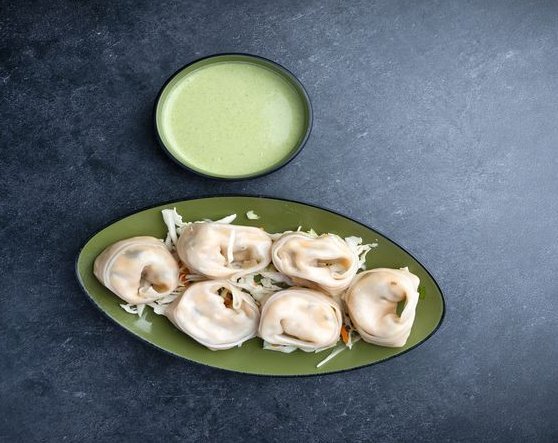
A search for momos near me Allen usually comes from somewhere specific: a video, a friend's recommendation, or a trip through the Himalayas that never quite left someone's appetite. Momos have quietly become one of the most recognized street foods in the world over the past decade, showing up on food shows, social media feeds, and city food-truck lineups far from where the dish actually started.
That global popularity has also blurred what a momo actually is. To a lot of first-time searchers, it reads as a generic word for "dumpling," when it's really a specific dish with its own origin, its own dough, and its own way of being eaten.
Most people searching best momos near me already have a mental picture of what they want: a thin-skinned dumpling, either steamed or fried, served with a spicy, tangy dipping sauce rather than the soy-vinegar mix associated with Chinese or Japanese dumplings. The question underneath the search is usually whether a nearby kitchen makes momos the way they're actually meant to be made, rather than serving a generic dumpling under a trending name.
Momos originated in Tibet and the Himalayan region, and were carried into Nepal largely through Newari traders from the Kathmandu Valley, who are widely credited with popularizing the dish and shaping the version most commonly eaten today. The dish itself likely traces back further to Chinese dumplings like jiaozi and baozi, which spread along trade routes through Central Asia and Tibet over centuries, before being adapted with local ingredients and techniques.
From there, momos spread through Nepal, Bhutan, and Northeast India, particularly Sikkim, Darjeeling, and Assam, where they became a defining street food long before reaching wider recognition elsewhere. Their more recent explosion into global street food culture is a relatively new development, driven heavily by social media, food festivals, and momo-specific food trucks in cities that have little historical connection to the dish, which is part of why the momo someone finds today can vary so widely depending on where it's made.
A momo wrapper is typically made from a simple, unleavened wheat dough, rolled thin and pleated by hand around the filling, which is usually minced meat or vegetables seasoned with ginger, garlic, and onion rather than the heavier soy-based seasoning common in East Asian dumplings. The pleating itself matters practically, not just visually, since a properly sealed momo holds its juices during steaming rather than leaking out and drying the filling.
The dipping sauce is one of the clearest identifiers of an authentic momo. Rather than a soy-vinegar dip, momos are traditionally served with a spicy tomato-based chutney, often built with sesame or Sichuan pepper depending on the region, giving the dish a tangy, heat-forward finish that's noticeably different from the milder dips paired with most other dumpling styles. Momos also come in more than one cooking style. Steamed momos are the most traditional version, while fried and pan-fried versions, sometimes called kothey, add a crisp, seared bottom while keeping the top soft, giving the same filling a different texture entirely.
Momos have become common enough on Indian restaurant menus in Allen that they're no longer treated as an unfamiliar item, but the quality still varies significantly between kitchens that make them fresh and ones that serve a mass-produced, frozen version reheated to order. At The Monks, located at 790 W Exchange Pkwy #140, momos are part of a menu built on made-to-order preparation rather than pre-cooked batches, the same approach that shapes the rest of the kitchen's cooking, from its curries to its Indo-Chinese dishes.
Momos sit at a natural crossing point between Himalayan, Indian, and Indo-Chinese cooking, which fits well within a kitchen that already treats Indo-Chinese food as a serious category rather than an afterthought. Anyone curious where momos land alongside the rest of the menu can browse the monksallen menu to see how they're grouped with the kitchen's other appetizers and small plates before deciding what to order.
Frequently Asked Questions
Not exactly. While momos likely share distant roots with Chinese dumplings like jiaozi, they developed their own identity in Tibet and Nepal, with a distinct dough, filling style, and, most notably, a spicy tomato-based chutney instead of a soy-vinegar dip.
Steamed momos keep the dough soft throughout and let the filling's flavor come through directly, while fried or pan-fried momos add a crisp, seared exterior, giving the same dish a noticeably different texture.
The momos themselves are typically mild, with the heat coming almost entirely from the accompanying chutney, which is usually the spiciest part of the dish.
Momos are best eaten hot, shortly after steaming or frying, so dine-in tends to give the truest first impression. For later orders, placing an online order directly with the restaurant helps minimize the gap between cooking and eating compared to third-party delivery apps.
A few things make a first momo order easier to navigate:
For anyone searching momos near me Allen for the first time, knowing the dish's actual origin and what a properly made version should taste like makes it much easier to judge a kitchen fairly. Questions about hours, location, or catering for larger groups are best answered by reaching out directly, rather than guessed at from a search result.